Tuesday, March 15, 2011

Do what you can for those in need in Japan

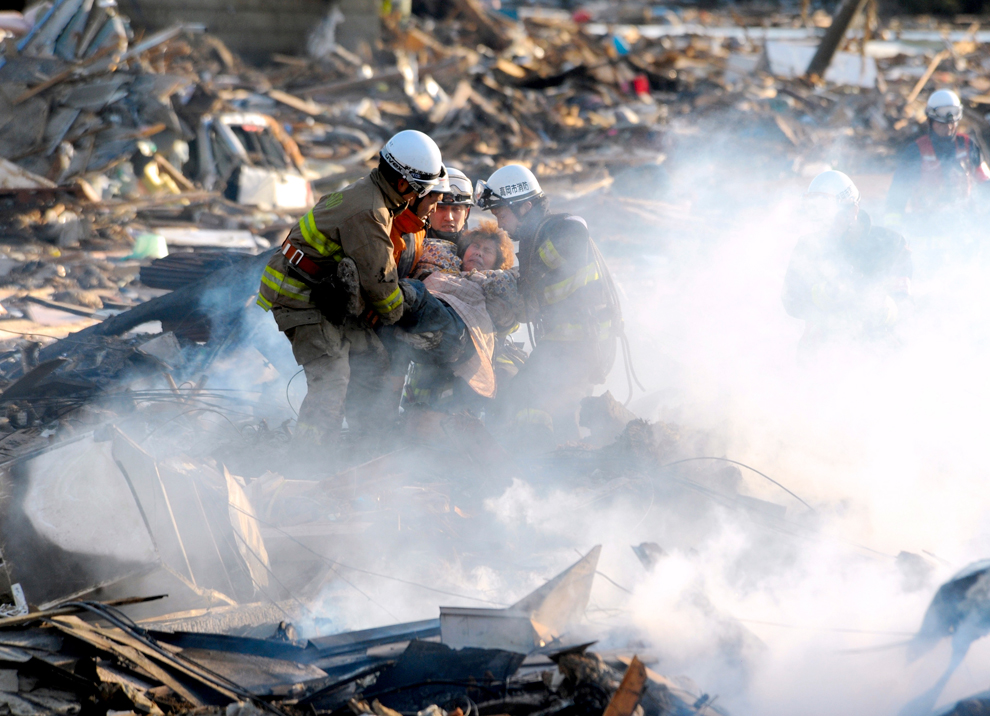
In conjunction to my previous post on work within New Orleans and natural disaster's effect on a society, I ask everyone to help support Japan in their time of need after the horrific earthquake and tsunami on March 11th. The Red Cross as made it as easy as possible by simply texting "REDCROSS" to 90999 to directly donate $10 to Japan disaster relief or simply going to www.redcross.org and making a donation there. Anything you can give is important.


Other sites to visit in an effort to help are:
To contribute to the medical relief or text MED to 80888 from any mobile phone to give $10

The Japan Earthquake and Tsunami Relief Fund at GlobalGiving.org works to provide donations to various relief organizations that promise to be working on immediate relief with the entire country.

Also visit, SaveTheChildren.org with their Children's Emergency Fund for disaster relief for the young people struggling.

Be sure to remember the animals as well at International Fund for Animal Welfare

More Sites: OperationUSA , MercyCorps , Doctors Without Borders , and Salvation Army

~~~At the very least, be sure to keep all of those effected by the earthquake and tsunami in your prayers and thoughts.

Emotion is the masterpiece of an artist's tools


This weekend the idea of extracting emotion from someone with writing or a photograph came into my head many times. Whether it was a photograph that I gifted someone and combined it with my writing or reading reports on the terrible wreckage of the tsunami in Japan and seeing the devastation it caused, the ability to make an effect on someone’s emotions is a powerful thing.
My goal as a writer and photographer (or “artist” if you consider it that) has always been to create an emotion out of my audience. Whether it is a smile, a surprise, a frown, or a tear, I take every emotion as a specific critique just as if a chef served their first dish of the evening and watched the customer’s reaction to the dish. Is it too spicy? Too sweet? Not enough flavor or a little more? All of these questions are how I improve my craft as anyone in a similar field would. And as they say, only a writer improves by reading other writers’ work and this also applies for artists. The more work you see, the more creative you can expand (or restrict) your work.

Monday, March 14, 2011

Can you judge a country by a book? Or vice versa?

So the old adage to never judge a book by its cover served new meaning when referring to travel within China. A country that has one of the world's most deeply-rooted histories and also some of the most well-known traditions can be very easily be typecast by the western world. My original impression of China, before traveling throughout the country, was of billions of people on top of each other, strict law enforcement and tremendous organization. Some pretty extreme typecasts.

Being the avid enthusiast of His Holiness The Dalai Lama, I was very interested in trying to get a sense of both sides of the story in reference to The Dalai Lama and his relationship with the Chinese government. So before starting my month long journey to China (and with wishful thinking Tibet), I began reading "Freedom in Exile" by His Holiness. Although hearing the rumors of the Chinese police kidnapping and arresting people who read The Dalai Lama's books, I wanted to actually see if that was true. So I took the risk, with the book in hand, as I stepped off the plane in Guangzhou. I made sure that the front of the book, which has a photograph of His Holiness, on it was to my side.

Tuesday, March 8, 2011

What Will 15 Minutes Be Worth?

Last night, while attending trivia at the local bar with my girlfriend, one of the questions was asked “Who was quoted by saying 'in the future everyone will get 15 minutes of fame'?” Sadly we answered incorrectly, although both of us knew the answer was of course Andy Warhol. (Sometimes I wonder why we even go to trivia when we can barely answer the layup questions). Anyway, Warhol's famous quotation made me think back to a week earlier when I ventured up to the northwest corner of New Jersey to a quaint little town of Knowlton to visit my girlfriend Kait's family. The cause for this trip was her grandfather, Neil (I still feel comfortable calling him Mr. Gallagher though), was turning 90 years old. Most of the family was in attendance to celebrate such a joyful occasion with this incredibly witty, charming, and knowledgeable man.


Prior to the party, I had the chance of meeting Mr. Gallagher a few times on different occasions, but most of what I know about him is through the rest of the family talking about him. And what I gathered from each and every member of the family was that the amount of respect and love that Mr. Gallagher has for his entire family is matched from his entire family. That only is truly inconceivable to me. If there was ever a person that is the foundation and groundwork of a family, he would be the epitome of it. Stories begin with him, passions form because of him, and knowledge stems from him. As any grandparent should be, Mr. Gallagher is the guiding light in this large family and he handles the role with almost a royal dignity.

As a fairly new addition to the Gallagher/Maillet family traditions and events, I enjoy just being a fly on the wall and listening to their stories. I especially enjoy when most anecdotes refer back to Mr. Gallagher. The reason being is that I rarely have had the chance to sit down and speak with him and get to know him a little more since I've been out of the country for a few years. All of the grand stories and things that this man has done in his life sound incredible, but it was not until I stepped into his home that this near legendary figure actually became humanized in my eyes.

Upon walking up to his second floor portion of the home, you can see an incredible juxtaposition of colors. Beautifully vibrant pieces of artwork of a lone soldier or abstract work with rich tones and brush strokes sit on the left wall, while to the right is an old bookshelf with stacks of novels and textbooks stuck behind a handful of very aged black and white photographs. It was an interesting contrast of art and history, color and black-and-white, new and old.

Going further into the house, there is a hall of fame. When I use the phrase “hall of fame” I do not mean to describe it by the cheapened version that most use it as, but rather to truly proclaim it a hall of incredible notoriety. Some may hang up high school trophies or momentous photographs of their childhood studded to the stucco, but this hall is truly of fame. Close to 30, all black and white photographs are well placed along the wall leading into the dining room and when examining more thoroughly, the feeling that you are walking through someone's 15 minutes becomes reality.

Photographs of Mr. Gallagher as Congressman with Presidents Kennedy and Johnson, with Frank Sinatra and famed Prime Ministers from across the world almost look fake, as if Photoshopped into the image. Every photograph had practically a novel's worth of a story behind them, and Mr. Gallagher himself could tell you each story right off the top of his head. And he did. He saw me looking in awe of these remarkable photographs just after our dinner, desserts, and speeches from his daughters and friends and decided to literally walk me down each minute of all fifteen of his that showed on the wall. It was truly incredible. Stories about families throwing events for him as he fought for civil rights down south and trips abroad to third-world countries to bring aid and kick start the Peace Corps would sound almost surreal if it were not in support of the photographs to back it up. It was a walk through time with someone that made a difference.

Following everyone's kind words and birthday wishes to him, Mr. Gallagher spoke to all of us in the room with great poise-- like a congressman would-- by thanking everyone in attendance but also leaving room for some jokes, stories and thoughts on his generation. He spoke about times while in service with the Navy, in Washington as a Congressman, and in New Jersey as a father, and all of these stories paralleled with his deep love for his wife, my girlfriend's grandmother whom he called “Rick”. He talked about those people he knew who died so young, literally over 70 years ago before their time was really up, and his ability to describe them as if they sat there with us that night was moving. He himself at times showed how surprised and shocked he was to make it to 90 years old, and how 90-year olds when he was young probably knew someone in their lifetime who knew George Washington; truly tying generations together. It was not until later in the night when the feeling that my generation has a much different outlook on things than those of the past. Looking at times he had in office and the history-making people he called by first name makes our generation seem minuscule in comparison.

Following his toast I thought about some interesting questions like, “who will I be telling my grandchildren about when I am 90 years old?” or “what famous personalities will we look back and talk about to truly show our age?” came into my mind. As history will always be written, it is interesting to think of how well it will be written when we're older. Will we look at Mark Zuckerburg as some see the Wright Brothers? Is Facebook as significant as man flying in a plane and air travel? Will we look at Justin Bieber (whom Mr. Gallagher did make reference to in his speech for an added punchline) as our Franky Blue Eyes? Will we consider the Gay Rights Movement as significant as the Civil Rights Movement? These questions cannot truly be answered just yet, but has looking back in history to compare it to the present times always seemed so disheartening? Perhaps I'm pessimistic in this regard but being able to recognize history in the making is like catching lightening, it is truly a rarity. But to be in attendance during a firsthand account of history being made (by a man who made a lot of it) seems to be just as impressive. The celebration of Mr. Gallagher's 90th birthday allowed me to better understand an incredible man, but also better understand a generational gap that has formed throughout the years. Most importantly, with a society where 15 minutes is achieved so much differently now than in his time, what will the next generations' 15 minutes look like?

Saturday, February 26, 2011

Photography's Impact

I just recently read an amazing article on Gizmodo.com which discusses the dramatic impact that photography had on the civil rights movement, specifically in the Project C protests in Birmingham, AL in 1963.

Please read this article, as it addresses the overwhelming influence of the photographs portraying the despicable treatment of African-Americans in the streets of Birmingham.

http://gizmodo.com/#!5763793/sound-familiar-photography-and-americas-civil-uprising

-----
I look at this article and make many comparisons toward recent events and/or social conflicts that I have lived through. For instance, the Coup De Tat of 2006 in Thailand, the hidden societal slandering of the Chinese government of the 50th anniversary of the Tibetan uprising, and the violent protests of Bangkok in 2010.

Thai, "Yellow shirt", protestors take over the Government House in downtown Bangkok, Thailand in August, 2008.

The affect of today's technology has obviously played incredible roles in all of these issues, with Twitter, Facebook and other social networks being the face of modernized uprisings and protests (as seen in Egypt, Tunisia, and Libya). So much so that even one Egyptian man named his newborn daughter "Facebook" after its largely influential impact on democratic overthrowing of Hosni Mumbarak just a few weeks ago.

But what has remained constant, over time, through struggle and discourse, is the element of images. Whether they are moving or still, colored or gray-scaled, focused or blurred, being able to capture the essence of a society, emotion, movement, or event is something any photographer strives for.

The beauty of capturing significant moments in time can only be as valuable as to document that moment accurately, justly, and appropriately. To skew a reader/viewer toward your bias or perspective is what some say is the right of every artist. But in a time of important change or struggle, say within a country's political system like Egypt's, putting your own spin on the situation is disgraceful.

I mention the Egyptian revolution specifically as my friend, Ghazala, has recently taken what is said in Gizmodo's article on the impact of photography during the civil rights movement and morphed it with the modern-day necessity of technology. Ghazala, a former fellow teacher of English in Thailand with me, has recently moved to Cairo for graduate studies. Upon arriving, the push for a change in power within the country occurred right before her eyes. And just like she did in Thailand during the protests of downtown Bangkok, she went into the heart of it like a good journalist would do -- not to mention a courageous journalist. And with risk comes reward. After snapping hundreds and hundreds of amazing images. Instead of concealing them for her own portfolio, she announced them with backstories and details into every incredible moment on Facebook and Twitter. Without bias, without prejudgement, but allowing for the photos to speak for themselves. With excellent photos comes emotion and reaction and that is precisely what happened with Ghazala's work. She was constantly on Facebook updating statuses and photographs, and on Twitter communicating with every person she knew about the crisis in Egypt but also informing the world of a fellow young adults view of the action. There were no CNN reporters standing on pedestals in front of crowds dressed in newly pressed shirts or even video of the chants echoing from Tahrir Square, but rather just raw images of struggle and hardship, all for one cause -- freedom.

After a few days, Ghazala's images reached a larger scale than her Twitter followers, but the Al Jazeera network, then featured in photography blogs, then publishing companies, then Egyptian individuals that simply want to document this revolution accurately for their children. The work of an inspired individual, foreign to the country, has passed inspiration to others, by being able to capture change and emotion.

You may not know Charles Moore of the Black Star who has many important photographs during the Project C protests in Birmingham in 1963, and perhaps you may never had the privilege to know Ghazala Irshad, but there work and their freeze frames in time -- in history -- is what you will remember. That's the beauty of a photographer. Being behind the camera may seem less glamorous to some than to me be in front of it, but all is relative. In a world where images of people are absorbed in and spit out by the hundreds a minutes, with advertisements and "famous" celebrities providing eye stimuli, the genuine nature of good images by a talented photographer is what matters in history. Fame may make the front page of newspapers and the back page of high school yearbooks, but photography makes all of the pages in history books.

Because when all else fails, when news networks can't get there, writers lose their words, and stories become misconstrued, truthful, compelling images will always prevail.